


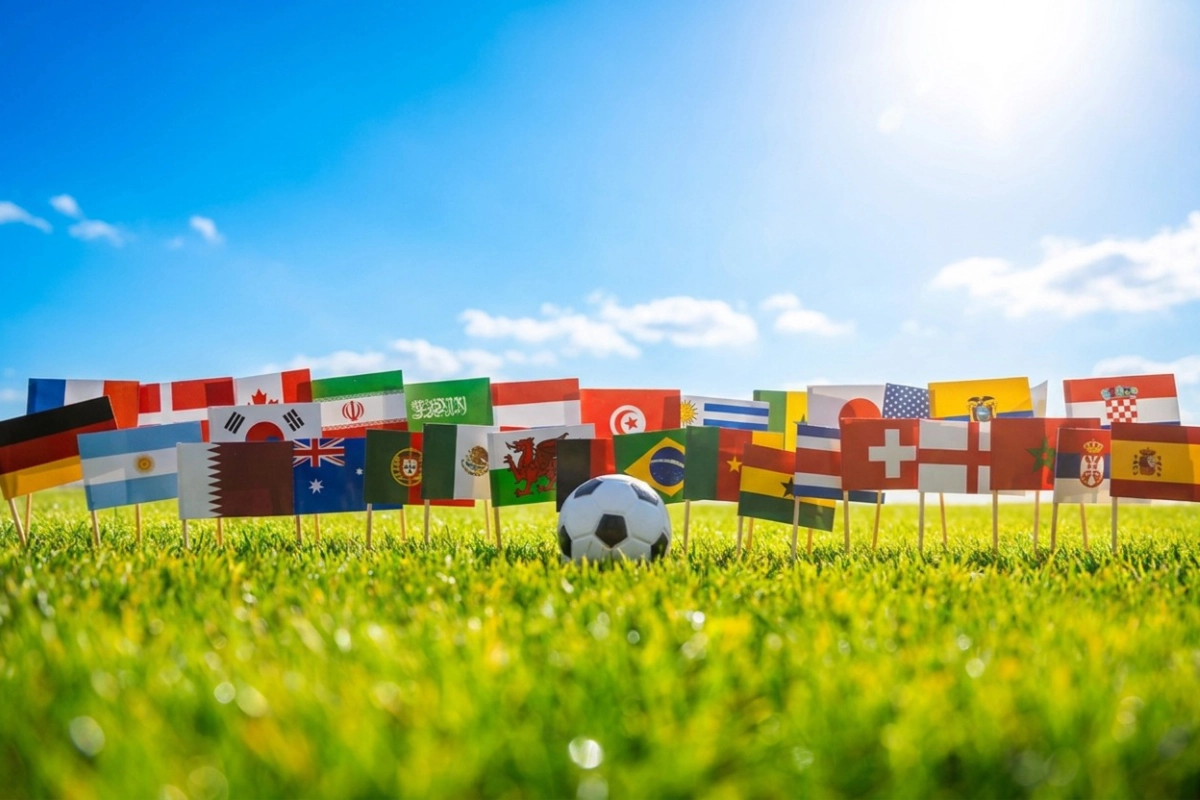
Few global events capture attention in quite the same way as the FIFA World Cup. Every four years, it brings together billions of viewers in a shared moment of international focus. While often viewed through the lens of sport and national pride, the tournament also offers a more nuanced narrative – one shaped by immigration, identity and the movement of people across borders.
In many respects, the modern World Cup reflects the realities of an interconnected world. The composition of national teams, the operation of the tournament itself and the broader conversations it prompts all point towards a single theme: migration is not peripheral to national identity, but integral to it.
Football has long been described as the “global game”, and that status has been shaped in no small part by migration. Players routinely move across jurisdictions to compete at club level, while diaspora communities maintain strong ties to footballing cultures across multiple countries. Over time, these patterns of movement have influenced not only domestic leagues, but also the identity and composition of national teams.
This is evident in recent World Cups. France’s 2018 victory highlighted the significance of long-standing migration patterns, particularly those linked to post-colonial histories across Africa and the Caribbean. Similarly, Morocco’s progression to the semi-finals in 2022 brought into focus the strength of its overseas communities, with several players born or raised in Europe choosing to represent their country of heritage. England provides a further example, with recent squads reflecting the diversity of modern British society and the contribution of successive generations of migrant families.
These developments are not exceptional. They reflect a broader shift in how identity is understood within international sport. National teams are no longer defined by narrow or singular narratives; instead, they represent layered identities shaped by history, law and lived experience.
At the heart of this sits a clear legal framework. FIFA’s eligibility rules are underpinned by principles familiar to immigration and nationality law: citizenship, descent and residence. The ability to represent a country may arise through birth, ancestry or naturalisation, recognising that individuals can hold meaningful connections to more than one jurisdiction. In this respect, the World Cup mirrors the complexity of modern immigration systems, where identity is increasingly multifaceted rather than fixed.
The role of diaspora communities further illustrates this point. Decisions about which country to represent often involve a balancing of personal identity, family heritage and professional opportunity. These choices are not merely sporting, they reflect the enduring transnational ties created through migration. Such connections extend across generations and continue to influence cultural and national affiliation in ways that traditional definitions of nationality may not fully capture.
Immigration also shapes the World Cup beyond the players themselves. The delivery of a tournament of this scale spanning four time zones, three countries and at locations up to 2,800 miles apart, depends on global labour mobility, cross-border expertise and extensive international coordination. Recent tournaments have brought increased scrutiny to these issues, particularly in relation to labour standards and regulatory frameworks. While these debates are essential, they also reinforce a broader point: events of this magnitude are only possible because of the movement of people and skills across borders.
Against this backdrop, the World Cup offers a useful counterpoint to more narrow or immediate discussions of immigration policy. Public debate often focuses on short-term pressures or constraints. Sport, by contrast, demonstrates the longer-term effects of migration – expanded talent pools, enriched cultural identity and strengthened national representation.
It also highlights the realities of an evolving national identity. The players representing their countries today frequently embody multiple influences, shaped by migration, integration and changing legal frameworks. The notion that identity is singular or static is increasingly difficult to sustain in this context. Rather, identity, both individual and national, is something that develops over time.
For policymakers and practitioners, there is a broader lesson here. Immigration is not simply an administrative or regulatory issue; it is a defining feature of how modern societies function and evolve. The outcomes of migration are often most visible over the long term, as communities become embedded and successive generations contribute across all areas of national life.
The FIFA World Cup offers a powerful illustration of this process. It shows that the movement of people does not weaken national identity; rather, it helps shape, enrich and strengthen it. Far from being at odds with national success, migration has often been integral to it.
Every four years, as the tournament unfolds, it offers a reminder that national teams, and the nations they represent, are products of history, law and migration. In that sense, the story of the World Cup is not only about football. It is also about the ongoing evolution of identity in a globalised world.