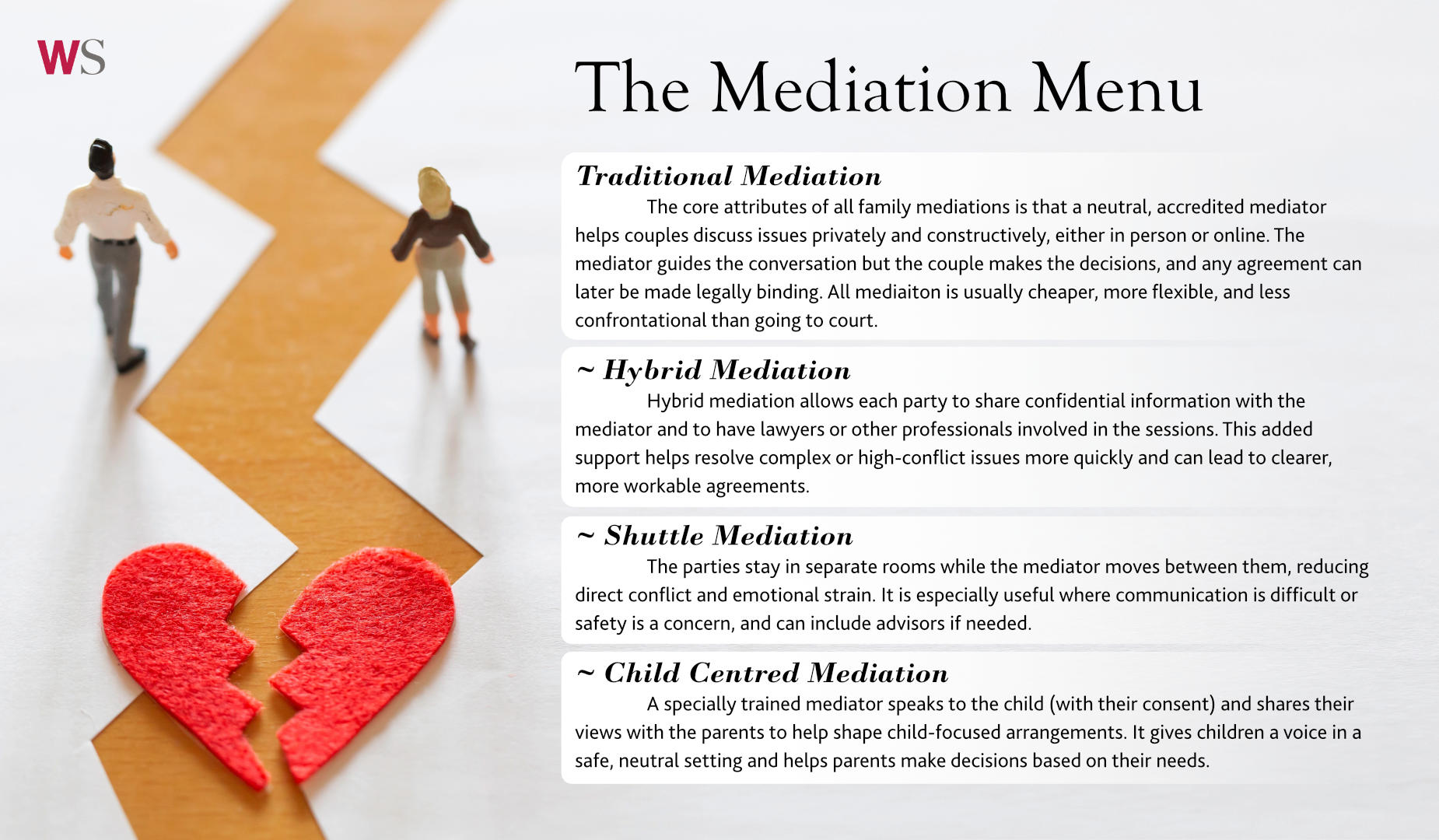


Family Mediation Week, taking place from 26 to 30 January 2026, seeks to raise awareness of the benefits of mediation for family law practitioners by way of promoting amicable solutions to otherwise contentious family issues.
By encouraging the practitioners to see the benefits and the types of mediation that are available, the industry is better placed to advise their clients of the same. If separating couples know anything about mediation, they may have a preconceived idea that it maybe a “one size fits all” solution, that would not be suitable for each family, where no two parents or families are the same.
But the truth is that family mediation has grown and adapted to be suitable for almost any family type with a ‘menu’ of options for the parties to choose from to make their mediation adapt to their separation. For that reason, it is one of the most popular and successful methods of reaching a resolution without involving the court system.
We explore the different types of mediation below, to demonstrate the flexibility of mediation to work with its users to find a resolution, whether over childcare arrangements, division of the matrimonial assets, or any other discrete issue that has arisen for that particular couple that the law may not necessarily have a rule book for.
1. Traditional mediation
The core features of a traditional mediation model flow through all the various types, as each is on a ‘without prejudice’ basis (meaning the negotiations and concessions made at mediation will not be open for a court to see, if the dispute between you ever did get to court.
It usually starts with the mediator having a conversation with both parties separately to understand the background of their separation and decide whether mediation (or what type of mediation) is right for them.
All mediations are also always facilitated by a mediator, who act as a neutral third party who is (or should be) specifically trained to identify the issues between the separating couples, and suggest ways of resolving those issues. It is best practice to make sure your mediator is accredited, and we would usually suggest that they are legally trained, to ensure you reach a resolution that is possible of being legally implemented. You can find a directory of accredited mediators through the Family Mediation Council. If successful, the outcome of that mediation will then usually go over to a solicitor to write up the resolution into a legally binding document.
Another common thread throughout all mediation is that most mediators have embraced remote working and mean you can have the sessions either in person (for that person touch) or online (so you have the comfort of your own home when going into a potentially stressful conversation).
How can mediation help me?
- Cheaper than going to court – there is even a mediation voucher scheme that you can apply for to contribute £500 to your mediation costs.
- Encourages open discussions in a neutral environment – generally starts the process off much less confrontational
- Can be used for specific issues, or more general arrangements – the court system can often be quite rigid, whereas mediation can suit the parties.
- While the mediator facilitates the discussions, the settlement is led by the couple – it is not imposed by a judge, or arbitrator who believes they know the best outcome for them, it is decided between the two people who know their situation best.
2. Hybrid / lawyer assisted mediation
Hybrid mediation combines traditional family mediation, with elements of civil mediation. The key difference between the hybrid model and the traditional model is that it allows the mediator to hold confidences with each person. This just means that the mediator can have one on one discussions with each person to understand their private aims from the settlement, as well as those they are comfortable discussing with their partner. The mediator would not be able to withhold factual information, but a “bottom line” of their offers can be shared with them, which helps the mediator find a workable middle ground and often accelerates settlement.
The main draw of hybrid mediation is that it allows the couple to bring lawyers, financial advisers, accountants, social workers, or valuers into the sessions. Some providers offer a psychotherapist to be present at the sessions, to assist with any emotional barriers to settlement.
Anecdotally, this method brings a swifter and more workable, legally robust outcome. Most may assume that bringing more professionals into the session would make the mediation process more costly, but usually it cuts down the number of sessions required, meaning that overall, it can be more cost effective.
How can hybrid mediation help me?
- Better support at the sessions – whether that is legally, emotionally, or just generally having someone else there to speak to in confidence if you are not sure of a suggested outcome.
- Where traditional mediation may not work where there is a power imbalance in the relationship, or in high-conflict divorces with complex financial cases, the additional expert support can aid resolution.
- The presence of advisors can reduce a power imbalance between the parties, as the “controlled” party can be supported in their views and positions.
- Swifter process – where solicitors are present, they can often draft up the relevant paperwork at the session, and agree it with the other party, to cut down on costs of lengthy legal correspondence to reach settlement.
3. Shuttle mediation
Shuttle mediation is a method where the parties never meet face-to-face. Instead, the mediator moves between them (i.e. shuttling between the two), presenting concerns, proposals, and offers to each side. The benefit is usually that the mediator can temper emotional languagethat may be blurted out in front of the other person, which can hamper settlement if it puts up emotional barriers to finding a compromise. If appropriate, the mediator can allow a friend or family member to sit in the room with them, as sitting in the room alone can often be quite daunting.
Where this is combined with hybrid meditation, the advisors are also in the room, for further support. A shuttle / hybrid mediation is similar to a private FDR (Financial Dispute Resolution appointment), which is a commonly used method of alternative dispute resolution. But the shuttle / hybrid model can be much cheaper as barristers and a private FDR judge are not required to attend, so these additional costs can be avoided.
How can shuttle mediation help me?
- In high conflict, or domestic abuse situations, shuttle mediation is essential to minimise the emotional impact on the parties.
- Even in situations where the couple are, at that stage, unable to communicate effectively due to the emotional fallout from the separation, it allows the mediator to translate their practical wants and aims, without emotional interference.
- The process can also be flexible: what can start as a shuttle mediation can transition to a joint meeting, if the couple feel able to.
4. Child-centred Mediation
Child-inclusive mediation is usually used for parties to agree childcare arrangements going forwards, whereby a specifically trained mediator will speak with the child (or children) separately, given they are of an appropriate age (usually around 6 and above, but it depends on the child). Where the child has given permission for their views to be shared, it is followed up with a feedback session with the parents. If better for the parents, they can combine this with shuttle mediation and hear the feedback separately. The feedback is then incorporated into the plan for child arrangements going forwards.
Children often feel uncertain or have mixed emotions when their parents separate. They may struggle to share these feelings directly and perhaps worry they will upset their parents. This method of mediation allows them to speak to a neutral person who is specifically trained to understand their concerns about their parents’ separation, so they feel heard and included in the process. It emulates the role of CAFCASS in the court system, a body who will speak to children who are impacted by their parents’ divorce and make recommendations to the court as to what the outcome of the proceedings should be, without the need to go to court for a resolution.
How can child-centred mediation help me?
- Reduce emotional stress on the child(ren), and therefore on the parents
- Depending on their age, empower children with a sense of involvement and voice during a difficult time.
- Helps parents reach an outcome that is genuinely centred on the child’s needs.
Every family’s situation is different, and the variety within the mediation menu ensures there is an approach to suit each one. By choosing the model that aligns with their needs—practical, emotional, or child‑focused—couples give themselves the best chance of reaching a balanced and constructive agreement.
If you want to find out more about any of the above types of mediation, get in touch with the Winckworth Sherwood Family Team, available through the links on this page.